

Biomarker Screening & Diagnostic Model
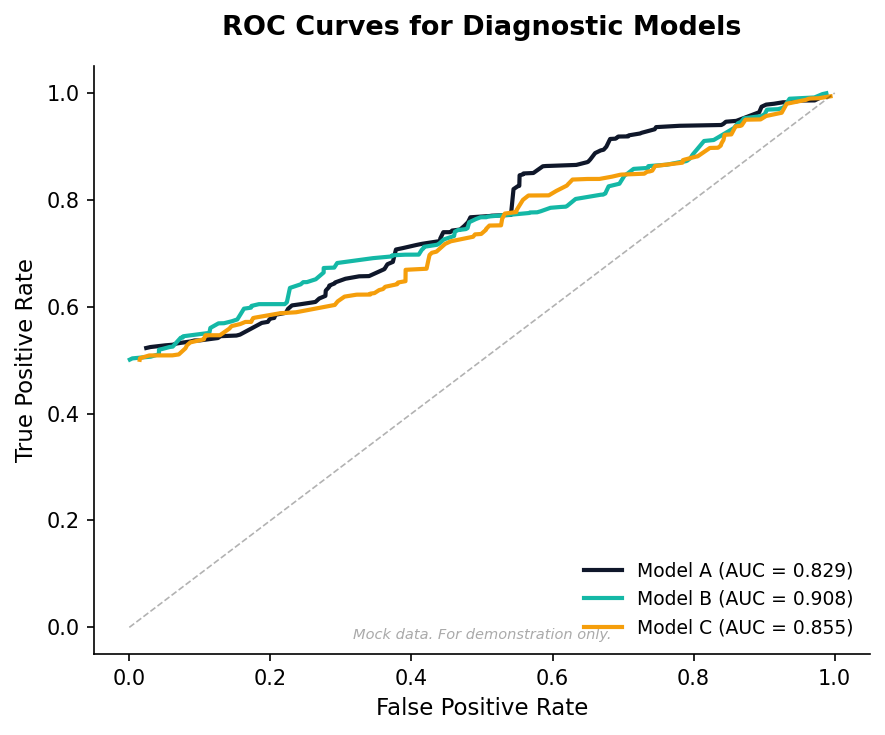
Representative ROC curve generated from mock data for layout demonstration.
This output represents the analytical approach and visualization style. Actual project results depend on input data quality, sample size, cohort diversity, and validation design. Not a clinical diagnostic tool.
Project Question
Can a multi-marker panel stratify patient subgroups and provide sufficient evidence to support biomarker prioritization before larger validation investment?
R&D Context
A translational research group was evaluating whether a candidate biomarker panel could differentiate disease states and support an early-phase biomarker hypothesis. The goal was to generate structured evidence for internal R&D prioritization decisions before committing to costly external validation studies.
Decision Challenge
The team needed to determine: (1) Which markers show consistent differential signal across training and hold-out cohorts? (2) Does the model maintain calibration and clinical utility potential in relevant subgroups? (3) Is the evidence strength sufficient to justify advancing to assay development and external validation?
Analysis Strategy
Performed differential expression analysis with biological relevance filtering, feature selection using stability criteria, and machine-learning model training with nested cross-validation. Evaluated subgroup performance, calibration curves, and decision curve analysis to assess potential clinical utility.
Key Findings
A 5-marker panel achieved AUC 0.87 with good calibration across the training cohort. Subgroup analysis revealed stable performance in most strata, with slightly reduced discrimination in one demographic group flagged for follow-up. Decision curve analysis suggested net benefit at clinically reasonable threshold ranges.
Why It Matters for R&D
The analysis provides a structured evidence package for biomarker prioritization — which markers to advance, which to deprioritize, and what evidence gaps remain before larger validation investment. It supports internal R&D milestone decisions, translational strategy discussions, and preliminary BD conversations.
Recommended Next Step
Validate the 5-marker panel in an independent external cohort. Investigate the subgroup performance discrepancy with additional covariates. Assess assay development feasibility for the top two markers and document regulatory pathway considerations.
Input Data
- Clinical cohort expression data
- Phenotype labels
- Validation cohort (if available)
- Known biological pathway context
Deliverables
- Biomarker ranking table with effect sizes and confidence intervals
- ROC / AUC / calibration / DCA visualization package
- Diagnostic scorecard with subgroup performance summary
- Translational interpretation and validation roadmap
- Methods documentation and known limitations