

Mendelian Randomization Causal Analysis
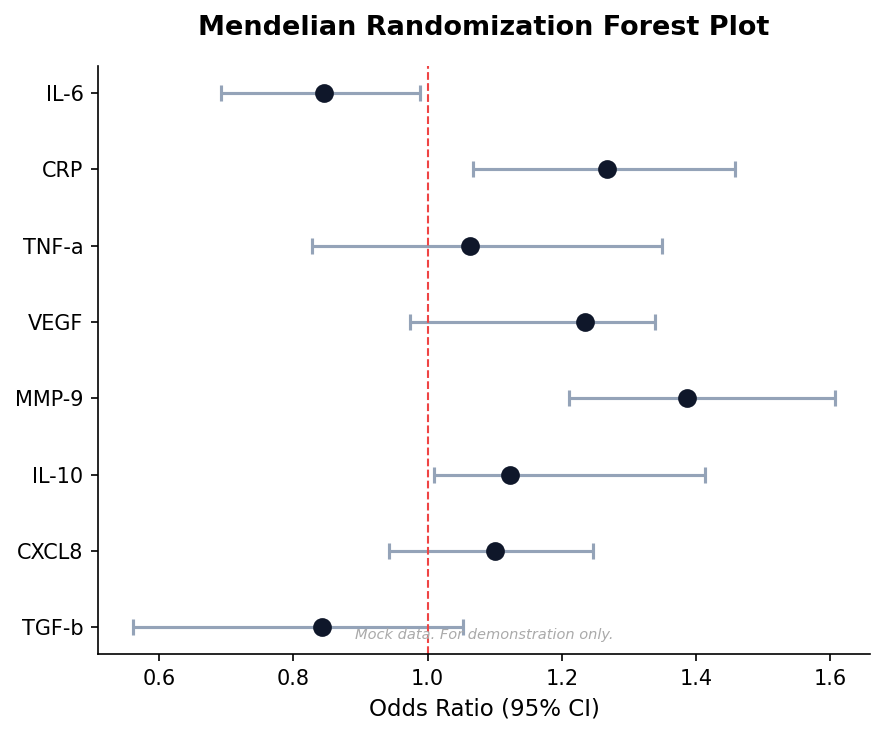
Representative MR forest plot generated from mock data for layout demonstration.
This output represents the analytical approach and visualization style. Actual project results depend on instrument strength, genetic architecture, and underlying assumptions of MR methods. Genetic evidence alone is not sufficient for clinical or regulatory decisions.
Project Question
Does genetic evidence support a causal relationship between a metabolic exposure and disease outcome strong enough to inform target prioritization?
R&D Context
A research group was evaluating whether observational associations between a metabolic exposure and a chronic disease outcome were likely causal, to inform target prioritization for a downstream drug discovery program and assess whether R&D investment in modulating this target was justified.
Decision Challenge
The central question was whether the genetic evidence was robust enough to support allocating R&D resources toward modulating this exposure as a therapeutic target, or whether confounding, reverse causation, and pleiotropy made the causal claim unreliable for decision-making.
Analysis Strategy
Selected genetic instruments from large-scale GWAS summary statistics using stringent F-statistic and linkage disequilibrium criteria. Applied multiple complementary MR methods (IVW, Weighted Median, MR-Egger) with comprehensive sensitivity analyses. Assessed horizontal pleiotropy, heterogeneity, and instrument strength.
Key Findings
IVW and Weighted Median showed directionally consistent causal estimates with overlapping confidence intervals. MR-Egger intercept suggested minimal directional pleiotropy. Leave-one-out analysis confirmed no single instrument drove the result. However, Cochran's Q indicated moderate heterogeneity, suggesting potential unmeasured pleiotropy or population stratification effects.
Why It Matters for R&D
The multi-method convergence provides moderate-to-strong genetic evidence supporting the exposure as a potentially causal risk factor. The documented heterogeneity and sensitivity results give decision-makers a balanced view of evidence strength and uncertainty — critical for go/no-go target evaluation, pipeline prioritization, and grant applications.
Recommended Next Step
Investigate sources of heterogeneity through stratified or multivariable MR. Perform colocalization analysis to assess whether exposure and outcome signals share the same causal variant. Evaluate druggability and competitive landscape of the target before advancing to experimental validation.
Input Data
- Exposure GWAS summary statistics
- Outcome GWAS summary statistics
- Instrument selection criteria
- Linkage disequilibrium reference panel
Deliverables
- Forest plot of causal estimates across MR methods
- Funnel plot and leave-one-out sensitivity analysis
- Heterogeneity and pleiotropy assessment report
- Evidence summary for target prioritization
- Methods documentation and instrument selection criteria