

Tumor Neoantigen Prediction & Ranking
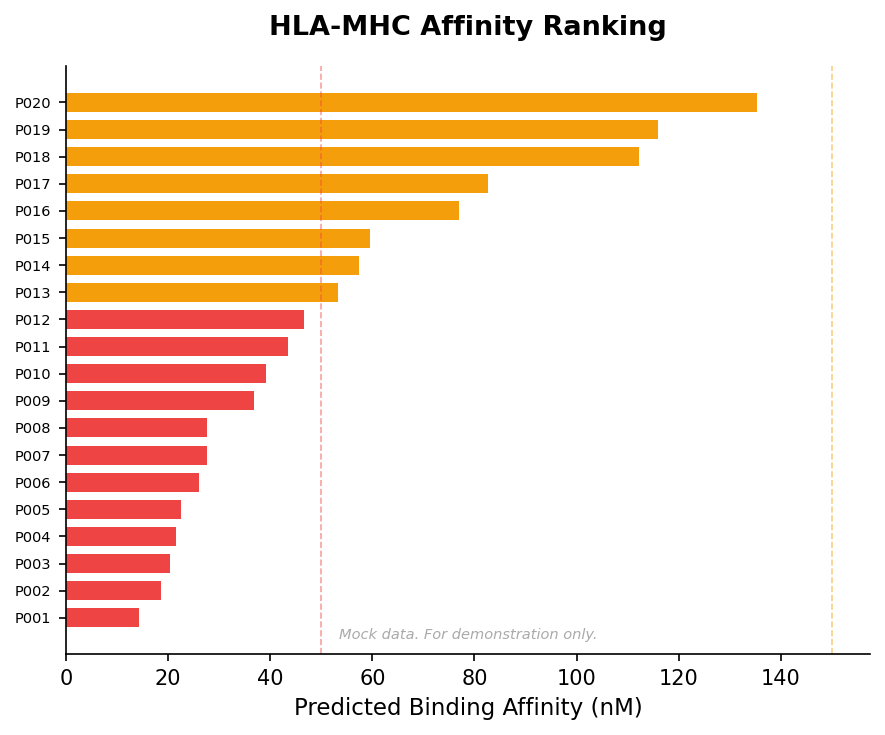
Representative HLA binding affinity heatmap generated from mock data for layout demonstration.
This output represents the analytical approach and visualization style. Actual project results depend on input data quality, sample size, HLA typing resolution, and validation strategy. Neoantigen prediction is research-only and not intended for clinical patient selection.
Project Question
Which neoantigen candidates should be prioritized for early experimental validation under a limited peptide synthesis budget?
R&D Context
An early-stage immuno-oncology research program needed to identify tumor neoantigen candidates most suitable for advancing to in-vitro validation. The team had a constrained budget for peptide synthesis and needed a data-driven shortlist to guide experimental prioritization.
Decision Challenge
With hundreds of computationally predicted neoantigens, the team faced two core questions: (1) Which candidates have the strongest combined evidence for immunogenicity across patient HLA types? (2) How should the shortlist be ranked to maximize the probability of generating measurable T-cell responses given limited synthesis capacity?
Analysis Strategy
Integrated in-silico HLA binding prediction, immunogenicity scoring, population HLA frequency weighting, and validation-readiness assessment. Candidates were tiered by composite score and annotated with supporting evidence for each ranking dimension.
Key Findings
Top-tier candidates showed consistent high binding affinity across multiple HLA alleles. Population-frequency weighting revealed a subset with broader cohort representativeness. Several candidates with strong binding but low immunogenicity scores were flagged for deprioritization. A sensitivity analysis showed ranking stability when varying HLA frequency thresholds.
Why It Matters for R&D
The ranked shortlist enables the research team to allocate limited experimental budget toward candidates with the highest probability of generating positive validation data. This reduces wasted synthesis and assay effort, accelerates the go/no-go timeline, and provides a documented rationale for internal R&D discussions and investor updates.
Recommended Next Step
Synthesize top-tier peptides for in-vitro binding validation and T-cell activation assays. If preliminary results are promising, expand to intermediate-tier candidates. Document HLA coverage gaps for potential follow-up with additional patient cohorts.
Input Data
- Tumor mutation data (VCF)
- Patient HLA typing
- Reference peptide libraries
- Population HLA frequency reference data
Deliverables
- Ranked neoantigen candidate shortlist with tier annotations
- HLA binding affinity heatmap and score distribution
- Population-frequency-weighted prioritization table
- Validation-oriented interpretation summary
- Methods documentation and parameter log